박인성 작가의 보이지 않는 축(Axis Invisible): 시간과 물질과 인간
이진명 / 미술비평철학박사
서구 사상은 존재의 의미를 찾는 물음의 기나긴 역사를 지닌다. 존재가 무엇이며, 어디에서 왔으며, 어디로 가는가와 같은 문제가 그것이다. 그런데 하이데거(Martin Heidegger, 1889-1976)는 존재, 정확히 존재자의 의미는 시간에 따라 달라지는 현상을 발견했다. 예컨대, 19세기 아카데미즘 그림은 당시 굉장했지만, 지금 사람들은 오히려 당시 천대받던 인상주의를 숭상하는 것에 반해 아카데미즘을 도외시하는 현상이 대표적이다. 존재는 시간의 맥락에 따라 그것의 의미가 변화한다. 존재는 시간과 협업한다. 존재는 시간에 좌우되며, 시간은 존재를 통해 자기를 드러낸다.
왕희지(王羲之, 303-361)가 <난정서(蘭亭序)>를 썼을 때가 영화(永和) 9년(353년) 3월 3일, 즉 상사일(上巳日)이었다. 이때 왕희지는 “세재(歲在……)”라는 표현을 쓴다. 별자리가 오유성(五遊星) 중에 목성(木星)이라는 별이 12년 중에 계축(癸丑) 지점에 자리하고 있다는 뜻이다. 장소는 회계(會稽), 지금으로 치면 소흥(紹興)이며, 산음(山陰)의 난정(蘭亭)이라는 정자에 친지와 모여서 술도 마시고 시도 지어 음송(吟誦)했다는 것이다. 이것이 천ㆍ지ㆍ인의 사고이다. 천(天)은 지(地)에 영향을 미친다. 천이 시간이고 지가 공간이기 때문이다. 우리의 지(지구)는 오유성의 위치에 따라 의미가 달라진다. 오유성의 힘 작용과 그 위치에 따라 의미가 달라지는 지구 사이에 살고 있는 인(존재)도 그들의 영향력에 좌우된다. 그러나 반대로 천(시간)과 지(공간)는 인(존재)에 의탁하여 자기 의미를 찾을 수밖에 없다. 천과 지와 인은 서로에 의지하여 자기 의미를 획득한다.
왕희지가 <난정서>를 쓴 시간은 해지기 전 오후로 추정되는데, 술에 취해 몇 글자를 틀리게 썼다. 다음날 다시 쓰고자 했으나 다시는 그 명필이 나오지 않았다. 그때 별의 위치나 시간, 분위기, 날씨, 공기, 바람, 햇빛 등 그 모든 것이 다르게 작용했기 때문이리라.
화가 박인성 역시 시간과 공간(물질)과 존재(작가)의 상호 개입의 의미를 찾는다. 현대의 디지털리티의 의미는 물론, 모더니티, 인간의 기나긴 역사, 시간, 공간, 존재의 의미를 사유한 연후에 그림을 그린다. 구체적으로 말하자면, 박인성의 예술은 언제나 기록의 파편들 위에 서있다. 그는 사진 한 장을 찍고, 그것을 현상하고, 디지털로 옮겨내는 일련의 과정을 통해 기록이 더는 사실을 담보하지 못한다는 점을 끊임없이 자백한다. 아날로그 필름은 현상 과정에서 산화되거나 훼손되고, 스캔으로 얻어진 디지털 데이터는 수없이 복제될 수 있을지언정 원본은 영원히 되돌릴 수 없는 상처를 입는다. 기록은 보존되는 순간 이미 파괴된 것이다. 일본만화 <북두신권(北斗の拳)>에서 주인공 겐시로가 악당을 처치하고 “너는 이미 죽어있다(お前はもう死んでいる).”라고 말하듯이 박인성의 회화는 이미 죽은 데이터를 적나라하게 드러낸다. 사진을 통한 기록의 본질, 나아가 우리 문명의 축인 디지털리티가 갖는 이 성스러운 모순을 정직하게 드러낸다.
박인성은 사진가의 전통적 방법론을 충실히 답습하면서도 그 답습의 끝에서 전혀 다른 길을 발견한다. 인화된 사진의 네 모서리에 핀을 꽂고, 마치 박물관의 유물을 보존하듯 액자 처리하는 행위는 사진이 가진 역사적 정통성을 존중하는 제스처이지만, 동시에 그것이 더 이상 동시대적 맥락과는 어긋난다는 사실을 스스로 고백하는 의식이기도 하다. 그가 보여주는 것은 완결된 기록이 아니라, 기록을 둘러싼 불완전한 조건과 균열의 과정이다.
박인성의 작업 과정은 고도로 세밀하게 설계되어 있으면서도, 필연적으로 우연에 개방되어있다. 아날로그 필름으로 촬영된 장면은 스캐너를 통해 디지털화되고, 홈프린트 크기로 잘려져 인화지 위에 출력된다. 이 파편화된 이미지들은 다시 캔버스 위에 콜라주 되고, 그 위에 에폭시가 부어져 경화 과정을 거친다. 바닥에 부어두었던 레진은 스스로 수평을 찾아 흐르지만, 완벽한 면을 이루지 못하고 때로는 얇은 막으로 굳어버리기도 한다. 며칠이 지나 캔버스를 바닥에서 뜯어내면, 화면 일부는 함께 떨어져 나가고, 표면은 벗겨져 요철을 드러낸다. 이 과정은 우연의 개입(시간과 공간의 상호작용)을 배제하지 않는다. 중력ㆍ기온ㆍ바람ㆍ시간의 경화에 따른 영향이 개입될 것이다. 그런데 오히려 작가는 그 불완전한 영향의 흔적을 존중하며, 때로는 작가의 의도적이거나 회화적(예술적) 개입을 가감한다. 때로는 있는 그대로, 즉 자연스럽게 이루어진 도료(바니시)로 마감한다. 그런데 중요한 것은 결과물이 아니다. 기록의 연쇄적 변환 과정에서 드러나는 균열과 흔적이야말로 박인성 예술이 기거하는 장소이다. 균열과 흔적은 천(시간)ㆍ지(장소, 물질)ㆍ인(작가)의 상호작용의 결과이기 때문이다. 더구나 해석이 내려지기 이전의 상호작용 결과이다. 박인성은 2023년 경주 솔거미술관 개인전을 기점으로 더는 하나의 주제 아래 연작을 지속하지 않게 되었다. <Behind the Veil>, <Stuffed Moments>, <Broken R.G.B.>와 같은 과거의 연작들은 하나의 문제의식을 서로 다른 양상으로 반복하며 탐구하는 실험작품의 연속이었다. 그림은 언제나 표면(surface)의 이야기이다. 그 표면 너머의 본질을 이야기하거나 시간을 통해서 물질의 의미를 드러내거나 전통적 CMYK 색의 체계에 도전하여 빛의 색채 요소이자 디지털리티를 떠받드는 RGB로써 전통적 회화 세계에 도전하는 예술적 서사를 구축해왔다. 그러나 이후의 작업은 개별 작품 단위로 전환되며, 각각이 독립된 서사를 품는다. 가령, 작가는 어두운 단색이 가부장적 색채로 존중받거나 장식적이고 다양한 색채가 여성적 색채로 폄훼되는 역사적 편견에 도전한다든지, 정확한 기록이 진리라고 여겨지는 편견을 뒤집으려고 도발하든지, 혹은 예술이 작가의 지향성과 의도를 정확히 반영하는가 우연이 작용하는가 하는 문제 등 끊임없이 문제를 제기하며 회화적 도전을 감행한다. 이는 예술의 세계는 원래부터 통일된 서사를 허용하지 않는다는 작가의 자각에서 비롯한 것이다. 사실상, 기록은 언제나 부분적이고 단편적이다. 어떤 순간을 붙잡으려는 시도는 곧바로 손상과 왜곡을 동반한다. 그 단편들은 결코 하나의 완전한 이야기로 봉합되지도 않는다. 그래서 그의 최근 작품들은 하나하나가 독립된 파편으로 제시되며, 전체가 아닌 단일한 파편의 미학을 드러낸다. 파편의 미학이야말로 21세기의 속성이기 때문이다. 동시에 21세기의 미학이기 때문이다. 이에 대해 박인성은 색채 회사 팬톤(Pantone)1)의 예시를 자기 회화에 도입하여 다음과 같은 질문을 한다. 팬톤은 색의 진리(truth)에 관심 없다. 다만 이해관계(interests)의 모델을 색으로 만들고 그것이 진리를 뛰어넘는 가치라고 주장하는 것이다. 챗지피티(Chat GTP)나 그로크(Grok)는 진리를 말하지 않는다. 21세기의 산업 유형으로서 자기가치를 주장할 뿐이다. 거짓말에 윤리적 아픔을 직시하지 못하고 그럴듯한 서술을 서슴지 않는다. 디지털리티 사진의 미학은 프로그래머의 코드 설정에 불과하다. 박인성 작가의 동시대 문명에의 질문은 쉽사리 끝나지 않는다. 따라서 굳이 그의 특성을 몇 개의 범주로 묶는다면 그의 작품에서 반복적으로 등장하는 소재가 크게 세 가지로 압축된다. 첫째, 기록의 동기, “즉 무엇을 남기려 하는가, 왜 남기려 하는가?”라는 질문. 둘째, 색, 앞서 말했던 팬톤에서 매년 지정하는 ‘올해의 색’이 하나의 사회적ㆍ문화적 코드로 끌려오는 것 같은 불편한 시대적 징후들. 셋째, 매체 변화에 따른 기록의 해석 차이, 즉 동일 사건조차 매체의 전환을 거치면 전혀 다른 방식으로 인식된다는 점. 미디어와 삶의 환경에 내재하는 불온한 점의 회화적 현시(顯示)야말로 박인성만이 견지하는 고유의 회화 세계라 할 수 있다. 이 세 가지 소재는 작가의 작업 세계를 유기적으로 엮는 보이지 않는 축(Axis Invisible)이 된다.
다음은 박인성의 작품 시리즈를 통해 그것의 특성과 의미를 표로 정리한 것이다.
다음은 박인성의 작품 시리즈를 통해 그것의 특성과 의미를 표로 정리한 것이다.
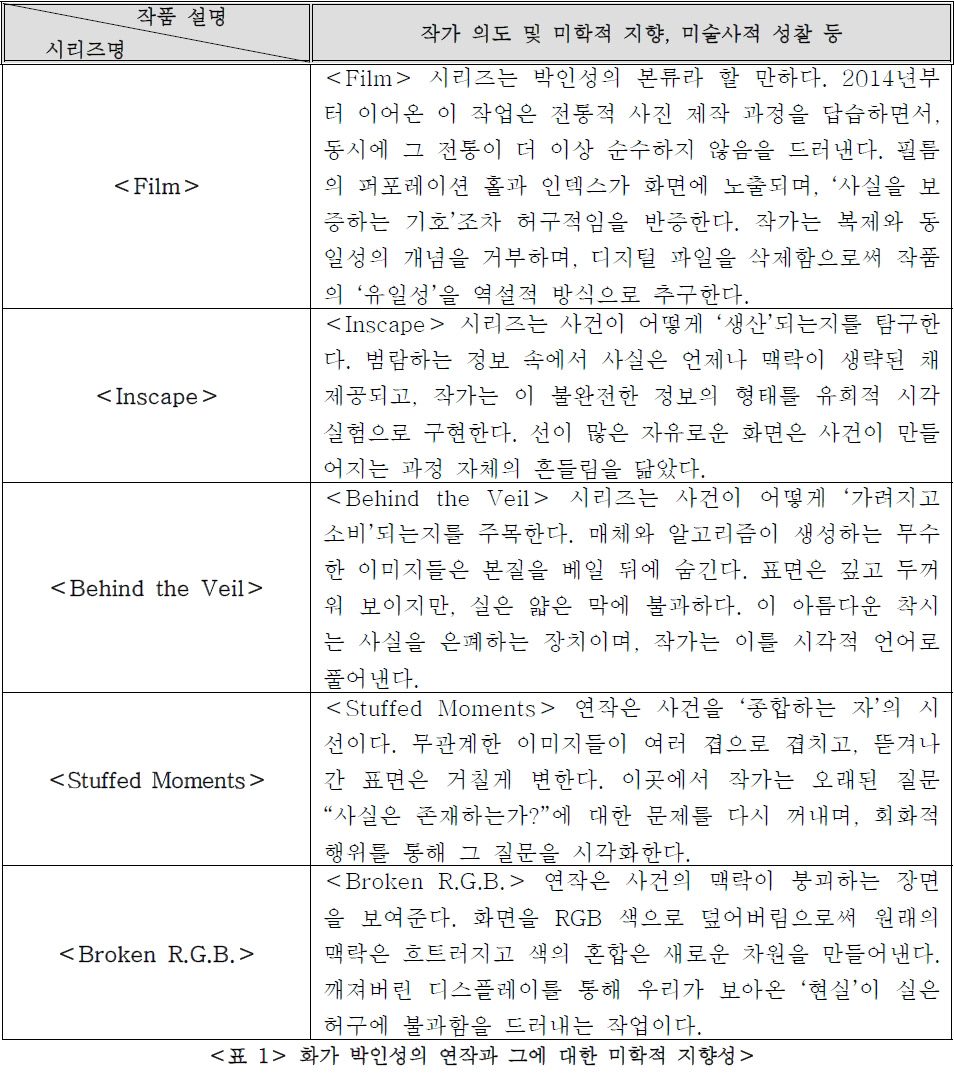
결국 박인성의 예술은 기록을 남기는 것이 아니라, 기록되지 못하는 것들을 드러내는 행위이다. 기록은 언제나 손상되고 왜곡되고 삭제된다. 그러나 바로 그 손상과 잔여 속에서 새로운 의미가 피어난다. 작가의 작품은 기록의 완결성을 약속하지 않는다. 오히려 균열과 불완전성, 그리고 그 사이에서 일어나는 우연의 작용을 적나라하게 보여준다. 박인성 회화의 힘은 미학적 쾌감에 있거니와 매체적 진실을 드러내는 쾌감, 즉 인간의 역사를 매체의 이동과정 바라보는 관점을 드러내는 쾌감에 자리한다. 그 쾌감은 성찰적 쾌감이며 인간의 역사를 옳은 방향으로 주도하려는 윤리적 쾌감이기에 의미가 깊은 것이다.
따라서 박인성 회화 앞에 서는 일은 단순히 한 장의 그림을 감상하는 행위가 아니다. 그것은 기록의 본질과 허구, 사실과 왜곡, 보존과 소멸이 얽힌 서스펜션에 몸을 내맡기는 경험이다. 긴장을 유발하는 시간과 공간과 인간의 의도의 결합이 박인성 회화의 토대라는 점을 상기하자. 우리는(관람자는) 박인성 회화의 화면 속 그 균열과 흔적에서 다음과 같은 결론과 마주하게 된다. 기록이란 것은, 즉 역사라는 것은, 즉 인간의 의식이라는 것은, 즉 우리의 본질이란 것은 늘 사라져나가면서 존재한다는 역설을 마주한다. 모든 살아가는 존재 안에, 그것이 역사건 의식이건 아이디어이건 간에 사라짐과 패퇴(敗退)를 동반한다는 것이다. 하나의 역사가 현현하면 패퇴를 맞이한다. 누군가 물극반(物極返)이라고도 했고 낙극생비(樂極生悲)라고도했다. 즐거움이 극에 이르면 반드시 슬픔이 생긴다. 회화라는 것도 그런 것이다. 박인성은 회화의 표면을 바라보지만, 그것의 이면에 숨어있는 오래된 시간까지 바라본다.
따라서 박인성 회화 앞에 서는 일은 단순히 한 장의 그림을 감상하는 행위가 아니다. 그것은 기록의 본질과 허구, 사실과 왜곡, 보존과 소멸이 얽힌 서스펜션에 몸을 내맡기는 경험이다. 긴장을 유발하는 시간과 공간과 인간의 의도의 결합이 박인성 회화의 토대라는 점을 상기하자. 우리는(관람자는) 박인성 회화의 화면 속 그 균열과 흔적에서 다음과 같은 결론과 마주하게 된다. 기록이란 것은, 즉 역사라는 것은, 즉 인간의 의식이라는 것은, 즉 우리의 본질이란 것은 늘 사라져나가면서 존재한다는 역설을 마주한다. 모든 살아가는 존재 안에, 그것이 역사건 의식이건 아이디어이건 간에 사라짐과 패퇴(敗退)를 동반한다는 것이다. 하나의 역사가 현현하면 패퇴를 맞이한다. 누군가 물극반(物極返)이라고도 했고 낙극생비(樂極生悲)라고도했다. 즐거움이 극에 이르면 반드시 슬픔이 생긴다. 회화라는 것도 그런 것이다. 박인성은 회화의 표면을 바라보지만, 그것의 이면에 숨어있는 오래된 시간까지 바라본다.
--------------------------------------------------------------------------------------------------------------------
1) 팬톤(Pantone)은 색채 연구 및 개발을 하는 미국의 기업으로, 색상에 고유 번호를 부여하는 팬톤매칭시스템(PMS)을 통해 그래픽 디자인, 패션, 인테리어 등 다양한 산업 분야에서 일관된 색상 구현을 가능하게 한다. 팬톤은 색상 전문 지식과 트렌드를 제공하며, 매년 ‘올해의 컬러’를 선정해 발표하는 것으로도 유명하다.
1) 팬톤(Pantone)은 색채 연구 및 개발을 하는 미국의 기업으로, 색상에 고유 번호를 부여하는 팬톤매칭시스템(PMS)을 통해 그래픽 디자인, 패션, 인테리어 등 다양한 산업 분야에서 일관된 색상 구현을 가능하게 한다. 팬톤은 색상 전문 지식과 트렌드를 제공하며, 매년 ‘올해의 컬러’를 선정해 발표하는 것으로도 유명하다.
The Invisible Axis in the Work of Park Inseong (Axis Invisible):
Time, Matter, and the Human
Lee, Jinmyung / Art Critic & Ph.D. in Philosophy
Western thought has a long history of questioning the meaning of being. What is being, where does it come from, and where is it going—these are the classic questions. Martin Heidegger (1889–1976), however, discovered that the meaning of being—more precisely, the meaning of beings—changes according to time. Nineteenth-century academic painting, for example, was considered magnificent in its own day, yet now people revere Impressionism, which was then despised, while largely neglecting academic painting. Being changes its meaning according to the temporal context. Being collaborates with time. Being is determined by time, and time reveals itself through beings.
When Wang Xizhi (303–361) wrote the Preface to the Orchid Pavilion (Lantingji Xu), it was the third day of the third month in the ninth year of the Yonghe era (353), the Day of Shangsi. At that moment Wang used the expression “sejae (歲在……).” This phrase refers to the position of Jupiter—one of the five visible planets—at the guichou (癸丑) point in its twelve-year cycle. The place was Kuaiji, present-day Shaoxing, at a pavilion called Lanting in the area of Shanyin. There he gathered with close friends, drank wine, and composed poems, which they recited aloud. This is the traditional triad of Heaven–Earth–Human. Heaven (tian) influences Earth (di): Heaven is time, Earth is space. Our Earth’s meaning changes according to the positions of the five planets. Humans (beings), who live between Earth and the shifting positions and forces of those planets, are also subject to their influence. Conversely, Heaven (time) and Earth (space) cannot help but rely on Human (being) in order to discover their own meaning. Heaven, Earth, and Human each gain their meaning through mutual dependence.
The moment when Wang Xizhi wrote the Lantingji Xu is presumed to have been late afternoon, just before sunset. Slightly drunk, he made a few mistakes in the characters. The next day he tried to rewrite it, but he was never again able to produce such a masterpiece. This must have been because the positions of the stars, the hour, the atmosphere, the weather, the air, the wind, and the sunlight all acted differently than the day before.
Painter Park Inseong likewise seeks the meaning of the mutual interventions of time, space (matter), and being (the artist). He paints only after reflecting on the significance of digitality in the present day, of modernity, of the long history of humankind, and of time, space, and being. More concretely, Park’s art always stands upon the fragments of records. Through the sequential processes of taking a photograph, developing it, and transferring it into the digital realm, he repeatedly confesses that records can no longer guarantee factual truth. Analog film is oxidized or damaged in the course of development, and the digital data obtained through scanning may be reproduced endlessly, but the original sustains an irreparable wound. The moment something is preserved as a record, it is already destroyed. Just as the protagonist Kenshiro in the Japanese manga Fist of the North Star (Hokuto no Ken) vanquishes his enemies and says, “You are already dead” (Omae wa mou shindeiru), Park’s painting exposes dead data with ruthless clarity. Through photography, he lays bare the essence of recording, and further, the sacred contradiction of digitality—the axis of our civilization.
Park faithfully follows the traditional methodologies of photography, yet at the end of this faithful repetition he discovers a completely different path. Pinning down the four corners of a printed photograph and framing it as if conserving a museum artifact is a gesture that respects the historical legitimacy of photography—but at the same time it is also a ritual acknowledgment that this tradition no longer aligns with the contemporary context. What he shows is not a completed record, but the incomplete conditions and fissured processes that surround recording.
Park Inseong’s working process is minutely planned and yet necessarily open to chance. Scenes shot on analog film are digitized through a scanner and printed, cut down to home-print size, onto photographic paper. These fragmented images are then collaged onto canvas, over which epoxy resin is poured and left to cure. The resin poured across the surface levels itself out as it flows, but it never achieves a perfectly smooth plane; at times it hardens into a thin, irregular skin. After several days, when the canvas is peeled up from the floor, parts of the image tear away with it, and the surface reveals abrasions and relief.
This process does not exclude the intervention of chance—that is, the mutual interaction of time and space. Gravity, temperature, wind, and the time required for curing all intervene. Yet the artist respects these imperfect traces of influence and, at times, adds or subtracts his own intentional or painterly (artistic) interventions. In some works, he leaves the paint layer (varnish) exactly as it has formed, with no further manipulation. What is crucial, however, is not the final product. The true dwelling place of Park’s art is the fissures and traces revealed in the chain of transformations that records undergo. Fissures and traces arise from the interaction of Heaven (time), Earth (place, matter), and Human (the artist). Furthermore, they are the result of interaction prior to any interpretive judgment.
Around the time of his solo exhibition at the Solgeo Art Museum in Gyeongju in 2023, Park stopped producing extended series under a single overarching theme. Earlier series such as Behind the Veil, Stuffed Moments, and Broken R.G.B. were sequences of experimental works that repeatedly explored one set of concerns through differing manifestations. Painting is always a matter of the surface. Park has constructed artistic narratives that question the essence behind the surface, reveal the meaning of matter through time, challenge the traditional CMYK system of color by mobilizing RGB—the color system of light and the backbone of digitality—against the world of traditional painting.
His subsequent work, however, has shifted to the unit of the individual piece, with each work containing its own independent narrative. For instance, he challenges the historical prejudice that valorizes dark, sober colors as patriarchal and demeans decorative, variegated colors as feminine. Or he provocatively overturns the assumption that precise recording is synonymous with truth. Or he raises the question of whether art faithfully reflects the artist’s intention and direction, or whether chance is at work. Through such questions, he pursues an ongoing painterly challenge. This stems from the artist’s awareness that the realm of art has never permitted a single, unified narrative. In fact, records are always partial and fragmentary. Any attempt to seize a moment is immediately accompanied by damage and distortion, and those fragments are never sutured into a single, complete story.
Thus his recent works present themselves one by one as independent fragments, revealing an aesthetics of the fragment rather than of the whole. This aesthetics of the fragment is precisely the condition—and the aesthetic—of the twenty-first century. In this context, Park adopts as an example in his painting the case of the color company Pantone1) and poses the following question. Pantone is not interested in the “truth” of color. It creates models of interests and power relations in color and claims that these hold a value that surpasses truth. ChatGPT or Grok does not speak truth either. As industrial forms proper to the twenty-first century, they assert their own value. They blithely produce plausible narratives without confronting the ethical pain of falsehood. The so-called aesthetics of digital photography is nothing more than the result of a programmer’s code settings. Park’s questioning of contemporary civilization does not come to an easy conclusion.
If we had to compress the recurring materials in his work into a few broad categories, three main motifs emerge.
First, the motivation for recording—“What do we wish to leave behind, and why do we wish to leave it?”
Second, color: the unsettling contemporary symptom that the “Color of the Year” designated annually by Pantone is dragged into our lives as a kind of social and cultural code.
Third, the differences in interpretation brought about by changes in media—that is, the fact that even the same event is perceived in entirely different ways once it is transferred from one medium to another.
The painterly manifestation of the disquiet inherent in media and in the conditions of life itself is the unique pictorial world that only Park Inseong sustains. These three motifs form the “invisible axis” that organically binds together the artist’s body of work.
The following table outlines the characteristics and meanings of Park’s major series.
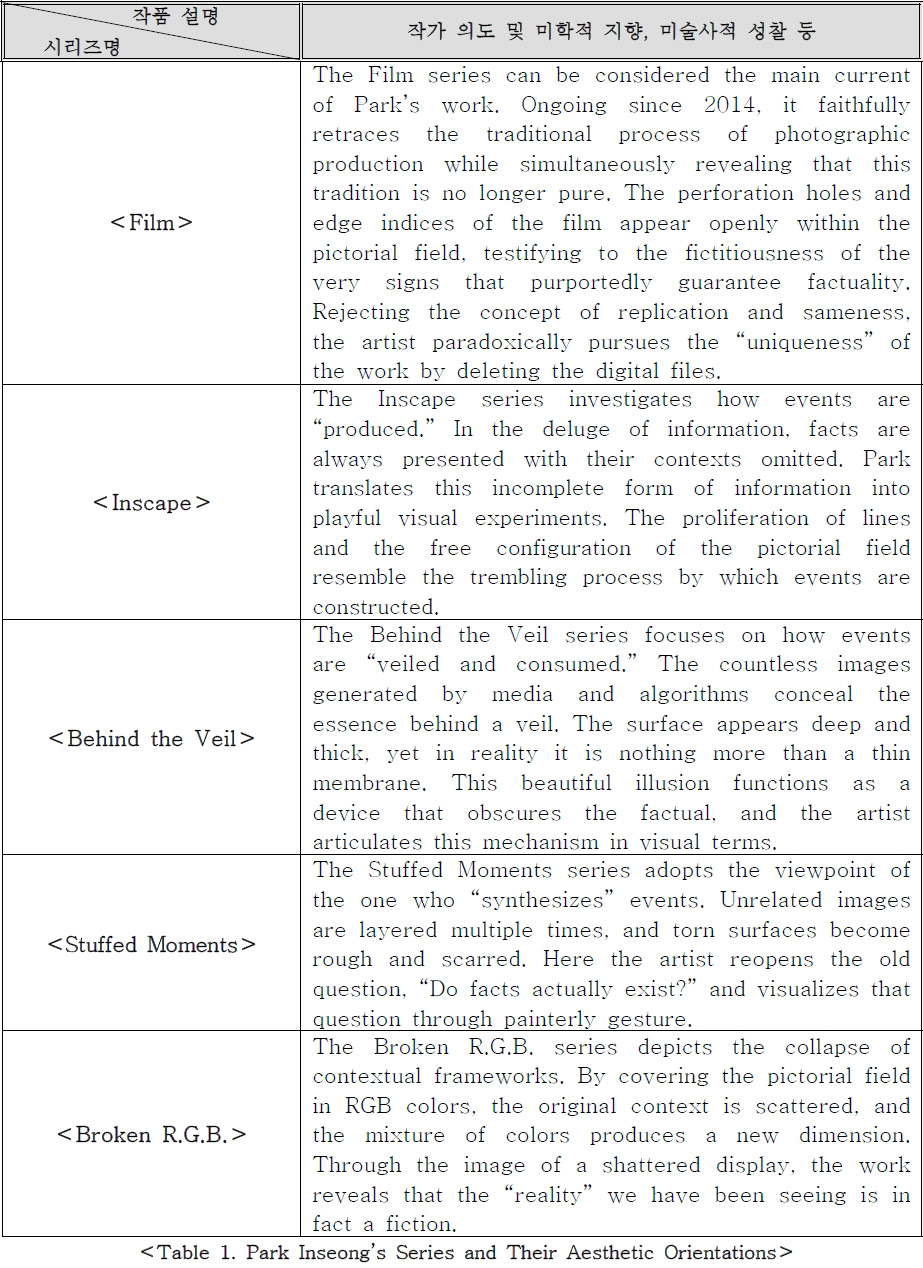
Ultimately, Park Inseong’s art is not an act of leaving records, but of revealing what cannot be recorded. Records are always subject to damage, distortion, and deletion. Yet it is precisely within that damage and remainder that new meanings emerge. His work does not promise the completeness of recording. On the contrary, it starkly presents fissures, incompleteness, and the operations of chance that occur in between. The power of Park’s painting lies in the aesthetic pleasure it affords—in particular, the pleasure of exposing the truth of media: the pleasure of viewing human history through the lens of media transitions. This pleasure is reflective, and because it is also an ethical pleasure—one that seeks to orient human history in a better direction—it is all the more significant.
To stand before a painting by Park Inseong, therefore, is not simply to appreciate a single image. It is to surrender oneself to a suspension in which the essence and fiction of the record, fact and distortion, preservation and disappearance are intricately entangled. We must recall that the foundation of his painting is the tense conjunction of time, space, and human intention.
Within the fissures and traces on the surfaces of Park’s works, we (the viewers) arrive at the following conclusion: records—that is, history, human consciousness, our very essence—always exist in the mode of disappearing. Every living being, whether in history, consciousness, or ideas, carries within it disappearance and decline. When one history manifests itself, it simultaneously sets in motion its own retreat. Someone once called this 物極返 (“when a thing reaches its extreme, it turns back”), or 樂極生悲 (“when joy reaches its extreme, sorrow arises”). Painting is no exception.
Park looks at the surface of painting, but at the same time he looks into the ancient time that lies concealed behind it
--------------------------------------------------------------------------------------------------------------------------------------------
1) Pantone is a U.S.-based company specializing in color research and development. Through its Pantone Matching System (PMS), which assigns a unique number to each hue, it enables consistent color reproduction across a wide range of industries, including graphic design, fashion, and interior design. Pantone provides professional expertise and trend forecasts in the field of color, and is also widely known for announcing its “Color of the Year” each year.