사실에서 구조로
문혜진 / 미술비평
박인성은 2014년의 한 메모에서 다음과 같은 이야기를 한 적이 있다. “만일 관객이 다큐멘터리 영화의 이야기를 전적으로 신뢰하거나 발생하는 서사의 전개를 진실한 시간의 배열이라고 이해한다면, 관객들이 수용하는 다큐멘터리의 요소는 사건일까 아니면 사실일까?”1) 박인성의 작업을 관통하는 핵심축 중 하나인 다큐멘터리의 외시성에 대한 의문은 이 질문 안에 함축되어 있다. 사실을 있는 그대로 전달한다는 다큐멘터리의 신화는 기호학과 후기구조주의의 강력한 도전에 힘입어 이미 상당 부분 무너졌고, 재현과 의미가 경합하는 여러 힘들의 상호작용으로 구성된다는 사실은 상식이 되었다. 그럼에도 박인성은 사진에서 출발하는 여러 매체들이 여전히 강력하고도 끈질기게 대상의 그림자에 매여있다고 본다. 빛이 필름에 닿는 순간만큼은 인간이 개입할 수 없다는 사진 지표(index)론과 진실을 보도한다는 다큐멘터리의 장르 정체성은 사실을 사실로 만드는 개입과 변형들을 가려 이미 해석이 가미되고 변질된 무언가를 사실로 받아들이게 만든다. 박인성이 말하는 사건은 진실이라고 여겨지는 표면적 사실 발생 이전의 상태를 일컫는다. 사실이란 언제나 이미 이차적 해석이 적용된 것이라는 점, 이를 만들어주는 구조를 드러내는 것이 이번 전시의 개념적 주제이자 박인성이 세계를 바라보는 근원적인 문제의식이다.
회화, 디지털 C 프린트, 영상 설치 등 ≪2020 올해의 청년 작가≫전의 출품작은 다양한 매체를 망라하고 있지만, 이들 역시 외재적 현상보다 구조를 드러낸다는 점에서는 기존의 문제의식을 계승한다. 그중 <프레임으로 인해>(2020)는 아날로그 사진 필름을 재료로 한다는 점에서 가장 직접적으로 기존작의 연장선 상에 있는 작업이다. <프레임으로 인해>는 동명의 사진 작업 3점(흑백 2점, 컬러 1점)으로 이루어진 연작이다. 우선 한 쌍으로 이루어진 흑백 작업부터 살펴보자. 아마 관객의 눈에 제일 먼저 들어오는 것은 4장 단위로 잘라 4줄로 배치한 4X4 배열의 필름 롤일 것이다. 퍼포레이션 홀의 존재는 필름의 물질성을 강하게 현시한다. 그런데 조금 멀리 떨어져 살펴보면 이 16개의 필름 프레임이 모여서 하나의 원을 형성한다는 것이 눈에 들어온다. 왼편의 작업은 바탕이 어둡고 원은 상대적으로 밝으며, 오른편의 작업은 반대로 원이 어둡고 바탕은 밝다. 한편 중앙에 놓인 컬러 작업은 붉은 바탕에 파란 원과 파란 바탕에 붉은 원이 번갈아 나타난다. 일차적으로 <프레임으로 인해>는 형상과 배경, 구상과 추상의 문제를 건드린다. 개별 프레임에서는 존재하지 않던 형상이 필름의 배치(arrangement)로 인해 떠오르기 때문이다. 그 역시 직사각형 띠 위에 연속적으로 나열된 원인 퍼포레이션 홀 또한 전체적인 그림(picture)의 일부를 이루며 큰 원과 작은 원이 교차하며 발생하는 구조적 아름다움과 리드미컬한 운동감을 생성한다. 그런 점에서 이 작업은 기하 추상을 사진적으로 시현했다고도 볼 수 있고, 필름의 물질성과 프레임을 강조했다는 점에서 구조 영화와 맞닿기도 한다. 하지만 <프레임으로 인해>는 보다 근원적으로 필름의 사실성에 대한 고찰에서 출발한다. 디지털 매체와 달리 아날로그 필름의 프레임은 촬영한 작가도 건드릴 수 없는 매체 본연의 골격이고, 각각의 프레임마다 박혀 있는 고유 번호와 정보들은 복제하거나 대체할 수 없는 필름 고유의 정체성이다. 박인성은 인화되지 않아 감춰지는, 하지만 촬영 당시의 정보를 있는 그대로 전달하는 프레임이야말로 이미지 이전에 존재하는 사진의 실재성이라 본다. “나에게 있어 완전한 화면 = 완전한 필름”2)이라는 작가의 말은 보이는 이미지는 이미 왜곡이 발생한 것이고 그보다 근원적인 상태는 프레임까지 포함된 필름 전체임을 의미한다. 프레임이 없었다면 구현되었을 완벽한 원의 환영은 검정 프레임 때문에 흩어지고, 분절로 인해 윤곽선은 약간씩 어긋나며 이미지의 환영은 더욱 파괴된다. 특히 컬러 작업의 경우 6줄로 구성된 필름 열을 휘어진 전시장의 모서리에 맞도록 분절 배치해 조각난 구가 더욱 파편적으로 보이게 된다. 결국 원이라는 이미지는 허상이고 실존하는 것은 각 필름 프레임뿐이며, 동일한 대상도 재현 장치와 구성에 따라 매번 다르게 보인다. 컬러 작업과 흑백 작업은 필름의 종류와 프레이밍을 달리한 것일 뿐 실상 동일한 피사체를 촬영한 것이다. 단 한 장의 프레임 누락도 없이 일련번호 순서대로 필름 롤 전체를 사용한 작업은 ‘있는 그대로’ 제시한다는 개념을 문자 그대로 물화한다.
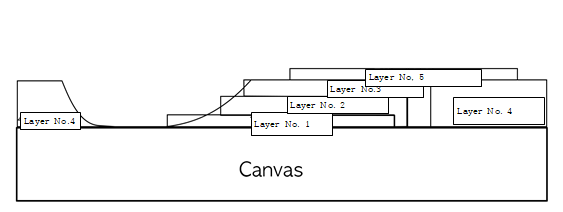
한편 이번 전시에서 처음으로 시도된 회화 역시 눈에 보이는 바와 실체가 일치하지 않는 간극을 다룬다. 신작 회화들은 이미지의 외양이나 제작 방식에서 사진을 닮았다. 구체적 형상 없이 사각 평면 위에 원이 등장한다는 외양적 특징도 <프레임으로 인해>와 연결되지만, 그보다 근본적인 점은 붓이 아니라 스퀴즈로 밀어 넣는 방식으로 이미지가 형성된다는 것이다. <고정 관점>(2020)의 경우 원을 표현할 부위에 종이를 올려놓고 바탕에 120-130번 이상 흰색 물감을 올려서 음각의 방식으로 형태를 만든다.3) 이후 빈 공간에 물감을 스퀴즈로 집어넣어 색점이 만들어진다. 작가의 주관이 배제되고 기계적인 방식으로 제작되는 작업은 사진적 회화에 다름 아니다. 특히 캔버스 위에 물감이 양각으로 부가되는 회화와 달리 이 작업의 경우 (음각을 채워 넣어서 형상이 만들어지므로) 배경과 형상의 층위가 동일하기 때문에 더욱 완벽히 평면이며 사진적이다. 여기서 방점은 최종 결과물보다 제작되는 과정에 있다. 얼핏 보기에 모노크롬 추상처럼 보이는 이미지는 표면에 물감층을 쌓고 밀어 넣는 행위가 반복된 결과물일 뿐이다. 연관된 작업 <이동 관점>(2020) 또한 비슷한 함의를 지닌다. 이 작업은 양각과 음각을 혼합해 제작되었다. 1번째에서 3번째에 이르는 물감층은 동심원을 약간씩 오른쪽으로 이동해가며 지층을 쌓는 방식으로 구축된다. 이때 동심원의 이동은 <프레임으로 인해>에서 원의 일부를 옮겨가며 촬영하는 카메라 렌즈의 시점 이동에 부합한다. 3번째까지 양각으로 층을 올린 후 4번째 층은 별도의 음각 원만을 제외하고 나머지를 모두 평평하게 흰색으로 채우고, 마지막 5번째 층은 그렇게 평준화된 표면 위에 다시 양각으로 얇게 얹힌다. 결과는 외시적 이미지와 제작 과정의 불일치다. 외견상 흰 평면 위에 그려진 하나의 원으로 보이는 회화는 실상 여러 단계의 물감층이 중첩된 표피가 일부 노출된 흔적일 뿐이다.
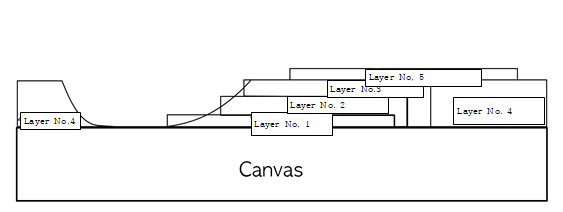
<이동관점(Moved Perspective)> 작업 과정도
동일해 보이는 이미지가 전혀 다른 방법으로 형성될 수 있고 역으로 같은 재료에 유사한 과정을 거쳐도 표면적으로 다른 이미지가 나올 수 있음을 박인성의 작업들은 스스로 체현한다. 영화 편집용 색 필름들을 동일한 순서로 이어붙인 필름 롤 3개가 시간이 지나면서 8mm 영사기의 물리적 속도 차이로 인해 다르게 재생되는 <Be Documentary>(2014)처럼, 박인성은 꾸준히 이미지와 실체의 비동일성에 대해 실험해왔다. 그런 점에서, 최종 이미지보다 과정, 사실보다 이를 구축하는 구조를 조명하는 박인성은 진정한 사진 비평은 이미지 비평이 아니라 장치비평이 되어야 한다는 명제를 실천하는 플루서(Vilem Flusser)적 의미의 작가다. 여기서 ‘삶이여 있는 그대로 영원하라!’는 지가 베르토프(Dziga Vertov)의 선언은 실재와의 외형적 유사성이라는 있는 그대로가 아니라, 표면 아래 잠재적 가능성들이 무수히 내재된 삶의 진정한 실체로서 있는 그대로가 된다.4)
---------------------------------------------------------------------------------------
1) 박인성 작가 노트, 2014.
2) 박인성 작가 노트, 2019.
3) 박인성 작가 인터뷰, 2020년 7월 21일 12-16시.
4) 오해를 피하기 위해 부언하면, 베르토프가 추구한 사실주의는 앙드레 바쟁이 가짜 리얼리즘이라고 비판하는 표면적 닮음에 기반한 실재의 재현이 아니라 가시적 외형 밑에 숨겨진 세계의 진정한 구조를 드러내는 것이다. 광학적 무의식을 구현하는 카메라의 눈(키노-아이)을 통해 보통의 눈으로는 불가능한 삶의 진실을 드러내어 대중을 각성시키고 역사적 변혁에 동참하는 것이 베르토프가 생각하는 이상적 사실주의였다. 그런고로 베르토프에게 ‘있는 그대로의 삶’은 세계의 실체, 곧 세상의 부르주아적 구조와 이로 인한 사회주의 혁명의 역사적 필연성을 뜻한다. 박인성이 베르토프를 인용한 맥락은 이와는 구분된다. 베르토프가 꿈꾼 사실주의와 달리 ‘삶이여 있는 그대로 영원하라’라는 슬로건은 여전히 가시적 유사성에서 벗어나지 못하고 있지 않나하는 것이 박인성의 생각이다. 그런 점에서 작가는 ‘있는 그대로’라는 문구가 지닌 여전한 신화를 비틀며 불가능한 기대와 희망이라는 점에서 베르토프를 전유해 전시 제목을 사용한다.
From a Fact to a Structure
Moon, Hye-jin / Art critic
Park Inseong once wrote this in a memo of 2014, "If audience fully trusts the story of a documentary film or understands the development of narrative that occurs in the film as arrangement of true time, could the elements accepted by the audience be an event or a fact?"1) This doubt about outward appearance of documentaries, the linchpin penetrating in the works of Park Inseong is implied in this question. The myth of documentaries delivering the fact as it is has already collapsed in a great part by the powerful challenge of semiotics and post-structuralism. The fact that documentaries comprise interaction of many forces where representation competes with meaning has now become a common sense. Despite this, Park Inseong believes that various media starting from photography are still tied to the shadow of the object in a powerful and persistent manner. The theory of photography index of which humans are not able to intervene at least at the moment the light touches the film and the genre identity of a documentary that is believed to report truth make it possible to hide the intervention and transformation making a fact a real fact encouraging the audience to accept something of which some interpretation has been already added and altered as a fact. The event Park Inseong talks about refers to a state prior to the occurrence of the superficial fact that is believed to be true. When it comes to a fact, the secondary interpretation had been already applied to it. For Park Inseong, revealing a structure creating this is the base of the conceptual theme of this exhibition as well as a fundamental critical mind looking at the world.
The works submitted to the exhibition of 2020 Young Artist of the year such as painting, digital C prints and video installation encompass a variety of media. However, these works inherit the previous critical mind in the sense that they also show a structure than an external phenomenon. In particular, Cuz of frame (2020) is a work placed as continuation of the existing works in the closest manner in that it is based on the analog photography film. Cuz of frame is a serial work composed of three works with the same name (two black-and-white works, one color work). To begin with, we will take a look at the black-and-white works composed of one pair. The first work the audience notices must be the film roll with 4x4 arrangement placed in four rows cut into four pieces. The presence of perforations strongly manifests materiality of the film. However, observing them from a distance for a while, we can realize that 16 film frames gathered to form a circle. The work on the left side has a dark background with a brighter color of the circle, while the work on the right side has a bright background with a darker color of the circle. On the other hand, the color work placed in the center repeats the figuration of circles made of blue circles with a red background and red circles with a blue background. Above all, Cuz of frame addresses the issues of figuration/ background and the concrete / the abstract. It is because the figuration that did not exist in a separate frame appears due to arrangement of the film. The perforations, which are the circles consecutively arranged on the rectangular bands also form part of the whole picture, creating structural beauty and rhythmical movement occurred when the big circles cross small ones. In this aspect, this work can be considered photographic manifestation of geometrical abstraction. This coincides with structural film in the sense that it emphasizes materiality and frame of film. Nonetheless, approaching the work Cuz of frame in a more fundamental perspective, its starting point consists in consideration of factuality of film. Unlike digital media, the frame of analog film is the intrinsic frame of media itself that even the artist who took the picture cannot intervene. At the same time, the serial number and information embedded in each frame are the unique film identity that cannot be duplicated or substituted. For Park Inseong, the frame itself hidden for not being printed but delivering faithfully the information from the moment of taking pictures is the very factuality of photography that exists before the image. The artist's comment regarding "A perfect screen for me = perfect film" means that the image has already experienced distortion, but a state that is more fundamental than that signifies the entire film including even the frame. If there had been no frame, the illusion of perfect circles would have dispersed because of the black frame, and the contour lines would have disagreed by the segmentation destroying the illusion of the image even more. In particular, the color work makes the broken sphere look more fragmentary by placing the film row composed of six rows as segments, fitting the crooked corner of the exhibition. Finally, the image called "circles" is illusion, and what really exists is nothing but each film frame, making the same object even look different according to the device and composition of representation. For color work and black-and-white works, the same subject of photography was taken and only the type and framing of the film varied. However, the work that used the whole film roll in order of serial numbers without leaving out even one piece of frame materializes the concept proposing "as it is," in the literal sense.
On the other hand, the painting that was tried for the first time in this exhibition also describes the gap between what is visible and the real substance. His new painting works resemble photography in terms of appearance of images and the production method. The external features having circles on the square plane without concrete shapes are also connected to Cuz of frame, but what is more fundamental than this consists in the fact that the image is created by pushing with squeeze and not by brushes. In case of Fixed idea (2020), by putting the paper on the area to express the circle, and repeating the white paint more than 120-130 times on the background, the artist creates the shape using the technique of intaglio. Later, by pushing the paint with squeeze into the empty space, the color stain is made. Excluding subjectivity of the artist, this work is created following a mechanical method. It is no different from photographic painting. In particular, unlike painting of which the paint is added on the canvas as relief, this work (of which the shape is made by filling intaglio) has the same level of background and figuration, so it is indisputably more flat and photographic. What must be emphasized here is the process of the production instead of the final result. At a glance, the image that looks like monochrome abstraction is nothing but a result of repeated act of piling paint layers on the surface and pushing them inward. The related work entitled Moved perspective (2020) also presents implication similar to this. This work was created by combining the techniques of relief and intaglio. The paint layers from the first to the third ones are formed by slowly moving the concentric circle to the right side to pile up the stratum. The movement of the concentric circle coincides with the movement of perspective of the camera lens that is taking pictures while moving a part of the circle in Cuz of frame. After piling up the level up to the third one in relief, for the fourth level, the artist evenly fills the rest parts in white, except the separate circle in intaglio. For the fifth level, the artist thinly adds paints in relief again on top of the flattened surface. The result reaches discord between external image and the production process. The painting that looks like the sole circle painted on a white plane at a glance is nothing but the trace of which the skin overlapped by paint layers with various levels is partially exposed. The images that look equal can be formed in a completely different manner. Contrariwise, despite the similar process using the same material, superficially different images can appear.
The works of Park Inseong embody this phenomenon by themselves. Park Inseong has been constantly doing experiment on non-identity of images and real substance or truth, as we can see in Be Documentary (2014). In this work, when three film rolls attached in the same order of color films for film editing are played in a different manner due to the physical speed difference made by the 8 mm projector, over time. Park Inseong casts light on the process rather than the final image or a structure that establishes it rather than a fact. In this aspect, he is understood from the significance of Vilém Flusser who practices the thesis of which true photographic criticism is supposed to be the criticism of devices and not the criticism of images. The declaration of Dziga Vertov, "Long live life as it is!" does not refer to "as it is" in the sense of external similarity, but "as it is" as a true substance of life infinitely inherent in potentials under the surface.
----------------------------------------------------------------------------------------------------------------------------------------------------------------------------------------------------------------------------------------------
1) Artist's statement of Park Inseong, 2014
2) Artist's statement of Park Inseong, 2019
3) Interview with Park Inseong, on July 21, 2020, 12 pm - 4 pm.
4) Making an additional remark to avoid any possible misunderstanding, realism pursued by Vertov is not about representation of reality based on the superficial likeness that André Bazin criticizes as false realism, but about revelation of a true structure of the world hidden beneath the visible appearance. Through the camera's eye (Kino-Eye) embodying optical unconsciousness, revealing truth of life to awaken people and participating in historical revolution was the ideal realism Vertov dreamed of. For this reason, for Vertov, "life as it is" means the substance of the world, in other words, the bourgeois-like structure of the world and the historical inevitability of a socialist revolution caused by this. The context of Park Inseong referring to Vertov is not in the same terrain. Park Inseong thinks that, unlike the realism Vertov dreamed of, the slogan, "Long live life as it is!" is not very distant from the visible similarity yet. In this aspect, the artist appropriates Vertov in a way to use for his exhibition title by distorting the myth of the slogan, "As it is," based on impossible expectation and hope.